


Deriva Lenta Slowbiking
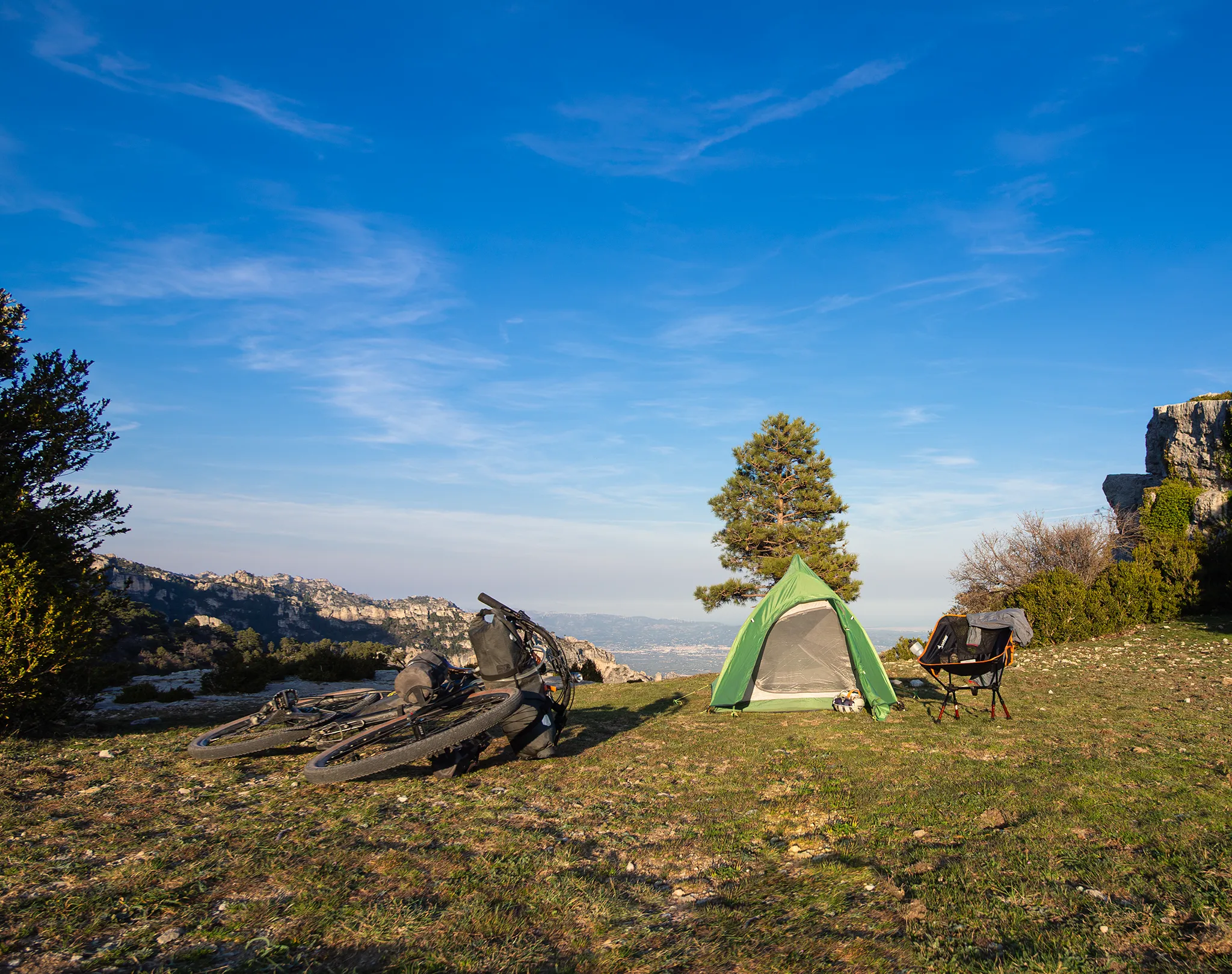
Deriva Lenta Slowbiking is a bikepacking route that crosses inland ranges before descending towards the Ebro and the Mediterranean. A journey built around loops, inviting a slow rhythm and a deeper way of moving through the landscape.
- Distance (km): 852 km
- Elevation gain (m): 13322 m
- Surface: Asphalt 49% / Gravel 51%
- Location: Baix Maestrat - Alt Maestrat - Els Ports - Matarraña - Baix Ebre - Montsià - Terra Alta
- Natural areas: Ebro Delta Natural Park - Els Ports Natural Park - Penyagolosa Natural Park - Serra d’Irta Natural Park - Tinença de Benifassà Natural Park
Table of Contents:
-
-
- Warning
- What is Deriva Lenta Slowbiking?
- The Philosophy of Deriva Lenta Slowbiking
- Part 1: A Giant Called Mont Caro
- Part 2: The Balcony of La Tinença
- Part 3: The Upper Maestrazgo
- Bonus Track: La Estrella
- Part 4: When the Inland Opens to the Mediterranean Sea
- Part 5: The Land of Monuments
- Part 6: The Peace of the Ebro Delta
- Considerations and material for the route
-
Warning:
I’m sorry, but this isn’t an easy route. I know that’s not the best way to invite you on an adventure (or maybe it is). I’d rather be honest: this journey asks for some preparation, a bit of planning, and the calm needed to truly savor it.
I’ve planned this route to share some of the “typical” rides I often take around here. Some have become autumn classics, as if written into the memory of the landscape, while others belong to summer, when the heat invites you to seek out natural pools hidden in narrow valleys. The difficulty doesn’t really come from the climbs (which, as you’ll see, are not few), but from a few stretches where you’ll need to push the bike. If you travel light, without panniers, you’ll hardly feel it; with them, patience will be your best companion. Yet none of this takes away from the beauty of the journey. Quite the opposite: those sections are part of what makes it whole, leading you to hidden corners whose easier alternatives would diminish the spirit of the route.
It’s not the easiest journey if you like to have your lodging booked in advance. It’s better to carry it with you, tied to the bike, with the freedom to stop wherever the road invites you to pause. Some villages are small, and their tourist infrastructure is modest, in keeping with the calm and unassuming spirit of these lands. That makes you improvise, trust the route more than the schedule, and let the journey write itself, one step at a time.
And isn’t that, after all, part of the charm? That touch of uncertainty turns each day into an invigorating challenge, a lesson in flexibility and trust. It’s not an easy route, but if you pace it wisely, it’s not a hard one either. It calls for patience, an open gaze, and the calm understanding that difficulty itself becomes an essential part of the experience.


What I can promise you is that it’s a truly beautiful route: a shifting mosaic of landscapes and rural lives, of rugged mountains and gentle farmlands, of misty beech forests and rice fields that glow golden at dusk. You’ll move from endless horizons where flamingos brush the winter lagoons with strokes of pink, to skies that seem freshly painted in summer. Along the way, you’ll meet Iberian ibex on impossible cliffs, raptors tracing spirals above the valleys, and villages that preserve the voices and customs born from centuries of mingling and migration.
My advice? Don’t hurry. Let slowbiking carry you with the drift. Enjoy every bend in the road, the silence broken by a river, a spontaneous chat with a local, and the soft blue the sky gifts these lands.
With the warning out of the way, let’s move on to introductions.
What is Deriva Lenta Slowbiking?
DL Slow is more than just a route, it’s a journey through diversity.
It weaves through regions stretching across Castellón, Teruel, and Tarragona, skirting rugged sierras and winding into hidden valleys. A route of contrasts, climbs that offer sweeping views and descents that lead to the freshness of crystal-clear pools.

You’ll climb mountain passes with endless views, cool off in natural pools sculpted in stone by patient water, and walk beneath the shade of Europe’s southernmost beech forest. Then, as if the journey itself paused for breath, the route unfolds into an inland sea of rice fields that shimmer like gold in summer, a sky alive with migratory birds and flamingos that tint the gaze pink in winter, and the quiet rhythm of greenways — perfect for pedaling at the unhurried pace this experience invites.
When night falls, if you choose to sleep under the open sky, you’ll discover a nearly forgotten luxury: a heaven untouched by light pollution, where the stars reveal themselves in calm abundance. With your camera (or simply with your eyes) you can trace the light and let the vast, silent sky become a canvas where fleeting moments turn into memories meant to last.
The suggested starting point is Tortosa, well connected by train, bus and road. You can begin wherever you wish, but it’s best to follow the direction outlined here. That way you’ll avoid adding extra difficulty to the pushing sections mentioned earlier, which I’ll describe in more detail later on.
The route is designed in sections, so you can shape it according to your time and strength. You can ride a single loop or link them all into one continuous experience, whichever best suits your drifting pace. In this way, I can also share it with you through the philosophy of Deriva Lenta, linking each section or loop to its Visual Tales or to individual Deriva entries.

The Philosophy of Deriva Lenta Slowbiking
DL Slow isn’t just about cycling, it’s a way of being in the world.
Here, distances aren’t measured in kilometers, but in moments. It doesn’t matter how many climbs you conquer or how many villages you pass through, but how deeply each place leaves its mark on you.
The bike becomes an excuse: a way to cross mountains and, at the same time, to shed the weight of hurry. Every curve is an invitation to pause, to listen to the whisper of a ravine, to sit in the square of a tiny village and let time drift without agenda.
To travel slowly is to reconnect with the essential: the crisp morning air, the scent of woodsmoke, the first star appearing as dusk settles. It’s remembering that beauty isn’t found in reaching the end, but in what unfolds between one point and the next.
That’s why this route isn’t about records or medals, but about experience. It’s a song to slowbiking, to wandering without a fixed destination, to getting lost with the calm of those who know that, in the end, every road leads us back to ourselves.
The Philosophy of Deriva Lenta Slowbiking
DL Slow isn’t just about cycling, it’s a way of being in the world.
Here, distances aren’t measured in kilometers, but in moments. It doesn’t matter how many climbs you conquer or how many villages you pass through, but how deeply each place leaves its mark on you.
The bike becomes an excuse: a way to cross mountains and, at the same time, to shed the weight of hurry. Every curve is an invitation to pause, to listen to the whisper of a ravine, to sit in the square of a tiny village and let time drift without agenda.
To travel slowly is to reconnect with the essential: the crisp morning air, the scent of woodsmoke, the first star appearing as dusk settles. It’s remembering that beauty isn’t found in reaching the end, but in what unfolds between one point and the next.
That’s why this route isn’t about records or medals, but about experience. It’s a song to slowbiking, to wandering without a fixed destination, to getting lost with the calm of those who know that, in the end, every road leads us back to ourselves.
Part 1: A Giant Called Mont Caro
If you’re the kind of person who likes to check the route profile before setting off, you might feel a chill when you see that it all begins beneath the final beast. Don’t worry: Mont Caro may intimidate, but it also enchants. If you climb it with patience, the ascent becomes a balm: a blend of effort and euphoria that seeps into you, curve after curve.
The journey begins at Tortosa’s red bridge, the gateway to the Greenway that links the city with Alcañiz. You’ll only ride its first few kilometers, just enough to wake up your legs as you leave the Ebro behind and draw closer to the mountain’s foot. Don’t worry, you’ll truly enjoy it on your way back, when the Greenway surrenders to gravity and the sheer joy of descent.

The climb to Mont Caro is fully paved, allowing you to pedal with your head held high and take in the sweeping views that unfold with every turn of the handlebars. You enter the territory of the Iberian ibex1, an emblem of these mountains. Agile and sure-footed, it moves across impossible cliffs with the same ease with which others walk across flat land. Though it has become increasingly difficult to spot one in the wild, its spirit lingers in every rock face. Halfway up the climb, near the Font del Caracol, you will come across a monument in its honour: a life-size sculpture perched on a rock, gazing with stony serenity at all the cyclists who suffer and delight with every pedal stroke on this pass.
When you finally reach the upper section, a choice opens up before you: to continue a few more kilometres and reach the summit (a must if it’s your first time), or to turn off onto the forest track that leads towards Fredes. From the top, the effort finds its reward: the gaze drifts across the vastness of the Ebro Delta, a tapestry of rice fields that turn golden in summer and, after the harvest, lie flooded, reflecting the sky before the landscape settles into its winter rest, while the Ebro River winds majestically on until it finally yields to the Mediterranean Sea.

That sight, a blend of grandeur and stillness, is one of the great gifts of this opening stretch, a quiet promise of everything yet to come.
Do plan your timing carefully. In summer, the heat can drain your water sooner than expected, while in winter, snow may force you to push the bike with your knees buried in white. The mountain has a strong temperament, and it deserves respect.
After descending towards Fredes along a beautiful yet demanding forest track, the pavement reappears, bidding us farewell to the Els Ports Natural Park and welcoming us into the Tinença de Benifassà Natural Park: a rugged and silent territory where griffon vultures glide over vast valleys and forests seem safe from the passage of time.
Part 2: The Balcony of La Tinença
Once we leave Fredes behind, the ride settles around a thousand meters above sea level, a kind of natural balcony from which the landscape unfolds as it would to a bird of prey. The steep slopes of Mont Caro are now behind you, and the effort turns into rhythm, that steady cadence that lets the traveler’s mind drift while the bicycle glides over a sea of mountains.
Crossing the Tinença de Benifassa means entering a rugged and silent land, where every bend in the road reveals a new balcony overlooking deep valleys, limestone ridges, and dense forests of pine and holm oak. The feeling is one of chosen isolation, of pure authenticity: few cars, few villages, and an endless sky. High on the cliffs, griffon vultures glide in slow circles, as if keeping company with your route.


Little by little, the terrain softens and the horizon opens wide, announcing the approach to Morella, the walled city. It rises in quiet majesty, encircled by more than two kilometers of medieval walls, with a castle perched atop the rock like an impossible nest. Its cobbled streets invite you to slow down, to lose yourself among Gothic gateways, noble houses, and squares where history still seems to breathe. Morella is not just a place to pass through; it is a pause, a reminder that every cycling journey also deserves a wander on foot.
After the visit, the route enters the Forcall valley, which unfolds surrounded by mountains like a natural shell. Its four rivers2meet in the heart of the village, whose layout preserves a medieval atmosphere, with stone arcades and a baroque church that surprises by its grandeur in such a small and secluded place. From here, the secondary roads lead toward the Sierra de Celumbres, where the terrain begins to climb again and the bicycle regains that slow but steady pedaling through open moorlands and mountain meadows. It is a stretch where the wind rules, and on clear days the views reach distant horizons that seem to go on forever.
Farther on lies Castellfort, one of the highest settlements in the region, where houses cling to the hillside and life seems shaped by the mountain and the winter cold.
This stretch, linking highland villages with the solitude of the mountains, weaves together the human and the wild: the quiet hospitality of the locals, the boundless landscapes of the sierra, and the whisper of the wind accompanying every turn of the pedals.
Part 3: The Upper Maestrazgo and its Bonus Track (La Estrella)
The journey moves into the Upper Maestrazgo, a land of history, stone, and quiet resilience. Here, the villages seem carved from rock and memory, clinging to impossible slopes or resting on high plateaus where the wind never stops its work.
The first stop is Villafranca del Cid, a town that once thrived on the wool trade and still preserves a medieval layout around its ancient walls. Cobbled streets, noble stone houses, and the feeling of a time that moves at its own unhurried pace.
Between Villafranca del Cid and Vistabella, hidden in a quiet ravine, lies La Estrella, a small village suspended in time that deserves a brief pause in the story.
From there, the route winds its way to Vistabella del Maestrat, the highest village in the Valencian Community, standing over 1,200 meters above sea level. Here, the air is crisp and clear, and the silhouette of Peñagolosa 3 rises on the horizon like a stone sentinel.
Very close by lies one of those places I hold with particular affection, one of those corners I always feel the need to return to: the free camping area of El Planàs4 within the Peñagolosa Natural Park. I have spent magical nights there beneath a sky full of stars, wrapped in a calm that only a place like this can offer. Sleeping in El Planàs is a reminder that the essentials fit inside a small tent and a handful of memories.

Farther along you’ll reach Chodos and Atzeneta del Maestrat, villages that still preserve the rural soul of this region. Whitewashed stone houses, small squares where life gathers around a fountain, and paths scented with earth and firewood. Between them, the ruins of old watchtowers whisper of a time when this land stood as a frontier for centuries.
The route continues towards Culla, perhaps one of the most beautiful villages of the Maestrazgo, officially declared a Historic-Artistic Site. Its steep streets, the fortified church and the remains of the old castle rise above the houses, creating one of the most recognisable silhouettes in these mountains.
From there the path opens into a calmer landscape, where history gradually gives way to ancient trees and quiet ravines. Nearby stands the Carrasca de Culla, a monumental tree officially protected as a Monumental Tree of the Valencian Community. This thousand-year-old holm oak, one of the largest and longest-living in the region, rises majestically in the landscape and can be admired from outside the estate that protects it.
Further ahead, the route enters the Barranc dels Horts5, one of the most remarkable natural landscapes in the entire region. Here the scenery changes suddenly. The path approaches the course of the ravine and an ancient woodland of Valencian oaks and holm oaks appears, accompanying the water and the small spring that emerges among the rocks.
The Alto Maestrazgo is like this: a blend of villages that endure, of history etched into old walls, of mountains shaping the horizon, and of places that, even in abandonment, remind us of the value of memory.
And although La Estrella lies beyond its borders, I wanted to include it in DL Slow, because its story fits perfectly into this journey: a reminder that routes are not only drawn on maps, but also by people.
La Estrella
Although it does not belong to the Upper Maestrazgo but to the municipality of Mosqueruela in Teruel, it deserves a special mention. To speak of La Estrella is to speak of Sinforosa and Martín.
For more than thirty years, they lived here in solitude, in this picturesque village suspended in silence, without electricity, without phone signal, holding on to a way of life that seems almost impossible in the twenty-first century.
In 2023, La Estrella joined the list of abandoned villages in what is often called the Spanish Lapland. Sinforosa, at ninety-two, had to move to a care home in Morella; Martín, at ninety, agreed to relocate to Vistabella with his son. Yet every week he returned to this place to feed the colony of cats, the only remaining inhabitants still enduring among the stones.
I was fortunate enough to meet him in 2023, during one of my routes, and to share a long, gentle conversation. There is such serenity in the elderly, such peace in their gaze, such an effortless way of putting daily life into perspective. It was the first time I dared to photograph someone outside my own circle. I wanted to keep his image as a tribute to a life devoted to the mountains and to simplicity.
La Estrella is now an empty village, yet in every stone and in every cat wandering its streets, you can still hear Martín’s gentle voice and sense Sinforosa’s quiet strength.
La Estrella
Although it does not belong to the Upper Maestrazgo but to the municipality of Mosqueruela in Teruel, it deserves a special mention. To speak of La Estrella is to speak of Sinforosa and Martín.
For more than thirty years, they lived here in solitude, in this picturesque village suspended in silence, without electricity, without phone signal, holding on to a way of life that seems almost impossible in the twenty-first century.
In 2023, La Estrella joined the list of abandoned villages in what is often called the Spanish Lapland. Sinforosa, at ninety-two, had to move to a care home in Morella; Martín, at ninety, agreed to relocate to Vistabella with his son. Yet every week he returned to this place to feed the colony of cats, the only remaining inhabitants still enduring among the stones.
I was fortunate enough to meet him in 2023, during one of my routes, and to share a long, gentle conversation. There is such serenity in the elderly, such peace in their gaze, such an effortless way of putting daily life into perspective. It was the first time I dared to photograph someone outside my own circle. I wanted to keep his image as a tribute to a life devoted to the mountains and to simplicity.
La Estrella is now an empty village, yet in every stone and in every cat wandering its streets, you can still hear Martín’s gentle voice and sense Sinforosa’s quiet strength.
Part 4: When the Inland Opens to the Mediterranean
Behind us lies the Upper Maestrazgo, with the imposing silhouette of the Mola d’Ares outlined against the sky and the picturesque, almost uninhabited hamlet of La Llàcua, seemingly resisting oblivion among stone terraces and old farmhouses. The journey then turns northeast, taking us once more into the Tinença de Benifassà, that land of silent mountains and deep valleys that welcomed us at the beginning of the route.

The road leads us to Vallibona, a whitewashed village clinging to the hillside, with narrow streets and balconies overlooking the mountains. From here, the road to Rossell winds its way through shifting scenery framed by trees and ever-changing views: dense forests, open meadows, and ravines that slice the mountains vertically. It is a stretch meant to be ridden slowly, letting your gaze drift toward the horizon.
Little by little, the landscape opens into the Baix Maestrat, where the mountains give way to cultivated fields. The route passes through historic villages such as Sant Mateu, with its imposing Gothic church and main square that has hosted markets and fairs since the Middle Ages; La Salzadella, known for the sweetness of its cherries; and Santa Magdalena de Pulpis, which still preserves the walls of its Templar castle perched atop the hill.
From here, the bicycle enters another natural treasure, the Serra d’Irta, a natural park that unfolds like a wild strip between the mountains and the sea. Its paths allow you to ride beside the Mediterranean, passing secluded coves, pine trees that nearly touch the shore, and the silhouette of Xivert Castle, watching from above as it has for centuries. The air changes here; it carries the scent of salt, resin, and open horizons.

The route then leads us to Peñíscola, its old town perched upon the rock, with the castle of Pope Luna gazing defiantly out to sea. After wandering for a while through its narrow cobbled streets, it is time to turn inland once more, but not before savoring the Mediterranean one last time along the beautiful promenade that stretches for seven kilometers of beach to Benicarló, the town where I was born.
Now surrounded by an agricultural landscape that shifts between green and ochre with the seasons, the fields of gnarled olive trees and rows of orange groves fill the air with their fragrance as you pedal toward La Sénia, a place of transition leading into one of the most beautiful areas for those who love autumn.
Here, when summer comes to an end, the forests offer a brief and delicate spectacle: leaves changing color from green to golden yellow, and from there to deep red, creating carpets of fallen leaves that crunch beneath the wheels.
Part 5: The Land of Monuments
If there is one stretch that captures the essence of this route, it is this one. For here, the “monuments” are not carved from stone nor shaped by human hands, but created by nature’s wisdom and the quiet patience of time. We enter the Els Ports Natural Park once again, where every turn reveals a new expression of grandeur.
The route begins with the climb to Casetes Velles, the access point to the Cova del Vidre. It opens at 1,120 meters above sea level under the spur of the Mola del Boix, on the right bank of the Lloret ravine. Its triangular mouth, of enormous dimensions (43 m long by 30 wide and 14 high), impresses the traveler who approaches it.

Oriented toward the east, the morning light filters into its depths, highlighting the textures of the rock and creating contrasts that seem like playful dances of shadow and light.
The cave, silent and cool even in summer, is one of the most unique places in the Els Ports Natural Park. A natural space full of symbolism, which invites both contemplation and humility before the strength of the mountain. A natural space full of symbolism, which invites both contemplation and humility before the strength of the mountain.
Soon after comes one of the toughest stretches, a steep ravine where you must carry the bike for about a three hundred meters. The secret lies in patience. Once this challenge is behind you, the effort is rewarded with a beautiful path descending toward one of the botanical treasures of the route, the southernmost beech forest in Europe.
There stands the Faig Pare, a majestic beech tree over 250 years old, rising 25 meters high with a trunk four meters around. Its twisted roots emerge from the earth like intertwined candelabra, holding the silence of the forest. For centuries, it has been a symbol of resilience, memory, and beauty in the Els Ports massif.
In 2024, a strong gust of wind broke one of its main branches, reminding us that even giants are not eternal.
In the gallery, you can find, as a tribute to this monumental tree 6, photographs of the Faig Pare before that wound, when it still unfolded all its majesty beneath the cool shadows of the beech forest.
The journey continues among beeches and yews until it meets another giant, the


From here, the road descends toward the Ulldecona reservoir, a stretch of calm water nestled among the mountains, reflecting the sky above. But the rest is short-lived, for it is time to climb again, a fair penance for so much beauty. The road rises once more to Fredes, now paved, allowing you to enjoy at ease the views and the whitewashed silhouette of the
The route continues toward the Tossal del Rei, a 1,350-meter summit where Aragon, Catalonia, and the Valencian Community meet. Here, a single stone marks the spot where three lands join hands, evoking the memory of the old Crown of Aragon.
From there we turn toward
After a long descent we arrive at Beceite, a mountain village where the murmur of water fills the air. Here you can choose to rest and explore the
Back on the main route, an essential stop is the Toll de Vidre, a clear natural pool with a small waterfall and a pebbled shore where travelers can cool off or simply lie in the sun.
Soon after, we enter

Not far away lies the Toll Blau, a pool of intensely blue water, hidden like a treasure at the foot of the mountain. A place the path approaches discreetly, inviting you to stop, dip your feet in the water, and let the silence of the surroundings do the rest.
From Horta we reconnect with the
The route can end here, at the red bridge of Tortosa, closing the circle where everything began. Yet it can also open to one last gift, the loop through the Ebro Delta, with its golden rice fields, winter flamingos, and the infinite calm of its plains. For this adventure, like the drift itself, does not always need an ending; sometimes it is enough simply to keep pedaling toward the horizon.
Part 6: The Peace of the Ebro Delta
There’s no better way to finish a route with so much elevation gain than by riding through a natural park whose highest natural mountain barely rises six meters above sea level. Many look down on the Ebro Delta because it offers no climbs or mountain passes; yet its magic lies precisely in the opposite. Here, effort isn’t measured in meters of ascent, but in moments of serenity.
The Delta is a place that heals. It soothes stress, sadness, boredom, and anxiety. Its peace is not found in climbs or technique, but along the greenways that wind through rice fields, in the stillness of its lagoons, and in the quiet grace of thousands of birds that live unhurried lives. Its villages blend seamlessly with the landscape, and its people hold the privilege of waking each day in a bucolic setting where life flows to the slow rhythm of nature.
From Tortosa, we head towards the Delta following the Val de Zafán Greenway to Amposta. Once there, it’s worth taking a short detour to the Ullals de Baltasar, freshwater springs that emerge from underground. These small circular ponds, between 3 and 7 metres deep, maintain a constant temperature throughout the year and host unique flora and fauna within the Delta. In a landscape dominated by rice fields, the ullals are small oases of biodiversity.
On the way back to the Ebro, we follow its bank along one of the Greenways until we reach the Mediterranean, where the route rewards us with Migjorn Beach, a stretch of sand open to the horizon. It is the perfect place to feel the meeting of river and sea, of journey and destination.
On the way back, the bicycle leads us to the Tancada lagoon, the spot with the highest concentration of flamingos in the entire Delta. Its brackish waters are teeming with life—gulls, ducks, cormorants—forming a mosaic of birds that turn this place into a spectacle for the senses. Three viewing platforms allow you to watch the gentle movement of the birds without disturbing them, privileged windows into a living ecosystem.

From lagoon to lagoon we arrive at l’Encanyissada, the largest in the Delta. There stands the Casa de Fusta, a wooden house built in the 1920s by hunters and now transformed into the natural park’s interpretation center. Inside, an ornithological museum reveals the richness of the birdlife that inhabits the Delta; outside, a viewing platform opens onto the lagoon, reminding us of the boundless scale of this horizontal landscape.
We then cross the Lo Passador Bridge over the Ebro River, and once on the opposite bank, the route enters its final act. Pedalling becomes even more unhurried, following quiet tracks that lead into the northern part of the Delta. Here the landscape opens up and silence gains presence: less traffic, more horizon, a stronger sense of riding through a land that invites observation without haste.
Soon after, one of the most evocative places along the route appears: the boat cemetery. Old wooden boats lie stranded on the mud, worn down by time and forgetfulness. There are no signs or solemn gestures; its power lies in what it suggests. They are remnants of a life tied to the river and to fishing, silent traces of a Delta that has always been changing, leaving fragments of its history behind.

Shortly after, the route connects Lo Goleró7and the Bassa de les Olles in a single, unhurried gesture. Two discreet spaces, open to sky and wind, where the Delta speaks in a low voice: shallow water, low vegetation, and the constant presence of birds that find refuge here. Riding through this section means moving carefully, almost as if asking permission, understanding that the Delta’s true richness does not seek attention, but simply endures.
From Bassa de les Olles, the journey begins a gentle return towards the interior of the Delta. The bicycle moves on between rice fields and canals until it reaches a greenway running parallel to the Ebro River, following its calm course. The river is no longer experienced as a destination or a frontier, but as a guiding thread that leads the final kilometres of the route.
The arrival into Tortosa comes without fanfare, allowing the body to absorb what has been lived. There is no abrupt ending or final climb to mark the close: only the steady flow of the Ebro River and the feeling of having completed a wide, generous circle that resists ending all at once.
The circle closes, but the calm of the Delta remains within. Because beyond mountains and sea, this final stretch confirms a simple truth: beauty is not always measured in height or effort. Sometimes it lives in forgotten boats, in a silent observatory, in a lagoon open to the wind, or in the simple act of riding alongside a river that moves unhurriedly towards the sea.
Deriva Lenta Slowbiking is not merely a succession of landscapes, mountains, and kilometers; it is an inner journey, an exercise in listening and stillness.
In every part of the route there is a hidden message: that there is no need to rush, that beauty is not always found at the summit, that getting lost is sometimes the way to be found. The bicycle, after all, is less a means of transport than an excuse to stop and truly see.
That is the spirit of Deriva Lenta: to live the journey as an end in itself, to ride not to arrive sooner but to arrive better, not to count the kilometers but to gather experiences along the way.
Because the true destination of this route is not in Tortosa, nor in Morella, nor in Benicarló, nor in the Delta.
It lies within you.
Deriva Lenta Slowbiking is not merely a succession of landscapes, mountains, and kilometers; it is an inner journey, an exercise in listening and stillness.
In every part of the route there is a hidden message: that there is no need to rush, that beauty is not always found at the summit, that getting lost is sometimes the way to be found. The bicycle, after all, is less a means of transport than an excuse to stop and truly see.
That is the spirit of Deriva Lenta: to live the journey as an end in itself, to ride not to arrive sooner but to arrive better, not to count the kilometers but to gather experiences along the way.
Because the true destination of this route is not in Tortosa, nor in Morella, nor in Benicarló, nor in the Delta.
It lies within you.
Considerations and material for the route
The Deriva Lenta Slowbiking route crosses very different landscapes and is organised into several independent loops.
For this reason, many practical considerations (such as points of interest, places to find water or specific terrain warnings) are explained on the pages dedicated to each loop. Including all that information in the main route description would make this section excessively long and difficult to consult.
Therefore, the detailed logistical information for the route can be found on the pages dedicated to each loop.
Wild camping is not permitted. Deriva Lenta is not responsible for how each person chooses to use the space. If you decide to spend the night in nature, please try to leave the place exactly as you found it, with no trace of your passage.
In each loop you will find the free shelters or paid accommodation I have identified along the areas through which the Deriva Lenta Slowbiking route passes.
The El Planàs camping area is free of charge, but its use is regulated by the Valencian Government in order to protect the environment of the Peñagolosa Natural Park. In the following link you can reserve a spot by searching by province (Castellón) and selecting the type of accommodation (camping area) 👉 Camping reservation portal.
Some sections of the route may change over time due to modifications to tracks, access points or local regulations. It is recommended to always check the most up-to-date information in the downloads section.

