


If there’s one route I’ve been longing to ride for quite some time, it’s Rodera’s Camí dels Assagadors. Why? Mainly because I’m Valencian. And, as such, I have to admit with a slight blush, that I still haven’t explored all the treasures of my own land. Rodera is precisely that: the perfect opportunity to venture into one of those corners I have yet to savour and reconnect with the beauty of a land that, to me, is among the most beautiful in the world.
Still present in the street names of many Valencian towns and villages, assagadors are ancient livestock trails dating back to the Middle Ages. Much narrower than the great drove roads, they forced livestock to move almost in single file, one animal behind another. For centuries, these trails connected the pastures of the inland mountains with the agricultural lands of the coast and were often laid out around settlements to avoid disturbance, the spread of disease and damage to crops.
In some way, Rodera brings that old transhumant spirit back to life: setting off from the Mediterranean, heading into the mountains along secondary tracks and ancient livestock trails and, after crossing a large part of the Valencian interior, eventually returning to the sea. A long coast-to-coast journey, avoiding major roads and larger towns whenever possible.
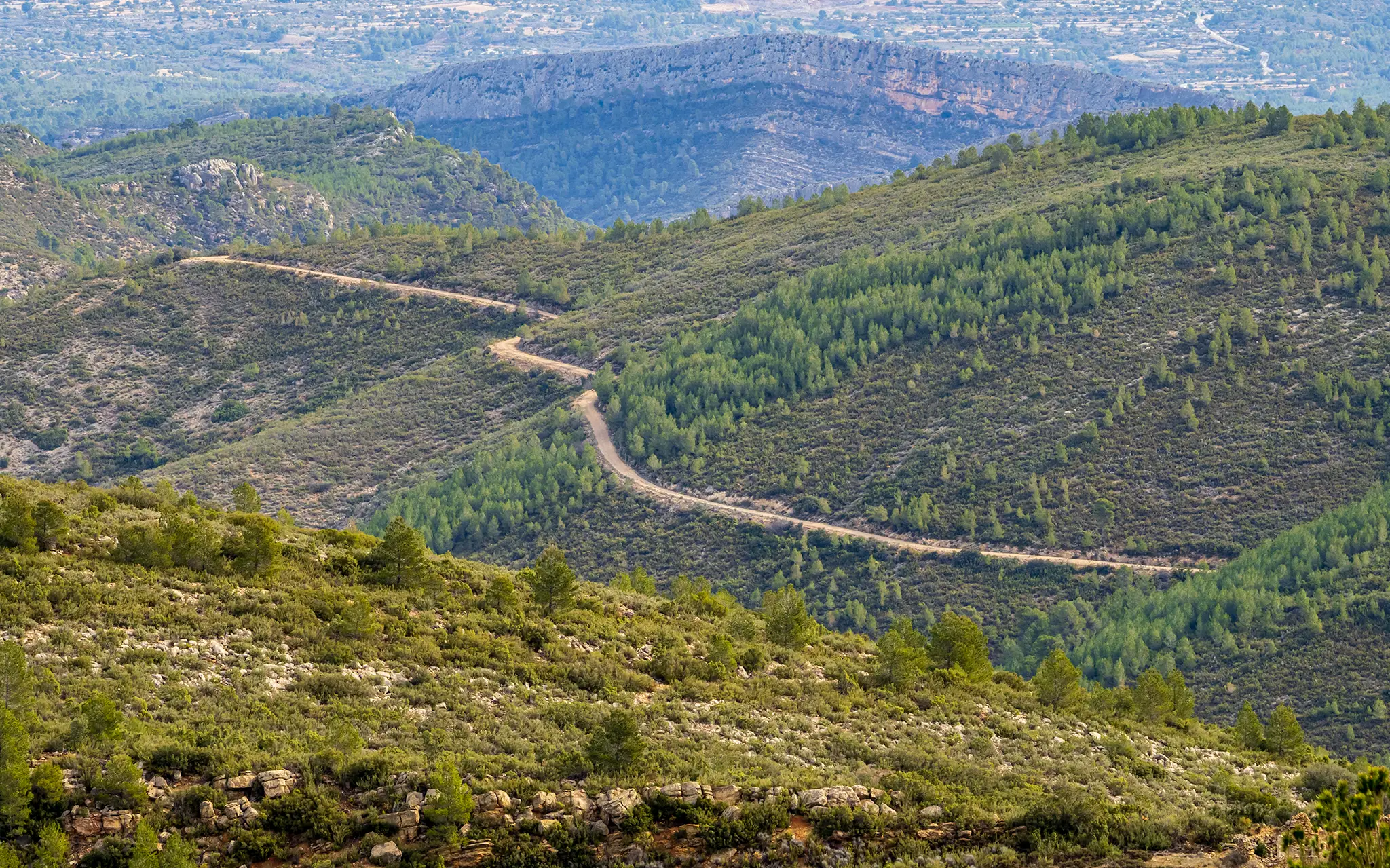
Deriva Lenta Slowbiking was born from much the same impulse: the desire to share my own playground, that corner of northern Valencia that inspires me so much. The Camí dels Assagadors winds its way through the heart of our territory, and I’m sure that, sooner or later, someone equally in love with the south will come along and invite us to discover those lands too.
Before taking on the entire route, I had the chance to enjoy a little weekend taster with a friend I’d met on one of the Bikepacking Gathering rides1. A fellow rider very much tuned into the same wavelength as Deriva Lenta. When he suggested the idea and I said yes, I knew I’d backed a winner.
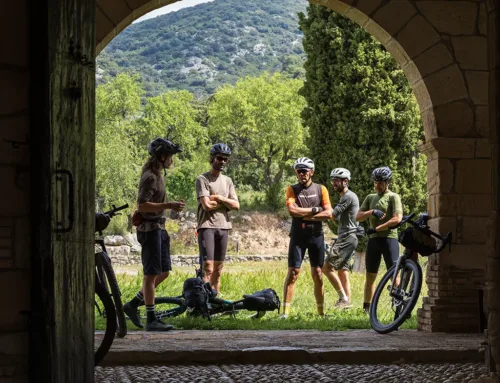
The folks at Rodera, always bringing good vibes, put together a short loop for us through the northern part of the route, the section closest to where we live: almost 150 kilometres and more than 3,600 metres of elevation gain over two days, giving us a taste of some of the landscapes the Camí passes through. Here’s the track on Wikiloc.
We made our way to Tuéjar to begin the ride. There, in the heart of the Valencian Serranía, we left the car behind and, after a good breakfast (because great adventures always seem to start better on a full stomach), finished getting the bikes ready.
We were eager to get going. Very eager.
That mixture of nerves and excitement that appears as you tighten the last strap and realise that, for the next few hours, your whole world is about to shrink to something as simple as following a line on the GPS.
And we started pedalling.
The roads soon gave way to tracks, leading us into a landscape of Mediterranean pine forests, holm oaks, dryland fields and ravines. A landscape in transition, rugged at times, where the woods open up to reveal cultivated fields before closing in around you again a few kilometres later.
Alpuente, La Yesa, La Cuevarruz, Corcolilla, Aras de los Olmos… Small villages appeared along the way like natural pauses in our journey. Quiet places, far removed from the noise of larger towns, where you get the feeling that the bicycle isn’t simply passing through the landscape, but adapting to its rhythm.
Perhaps that’s why I particularly enjoyed finding so many well-maintained forest shelters along the route. Not only as a cyclist myself, but also because of the possibilities they offer for people with very different ways of travelling to enjoy routes like this.
I love pitching my tent and sleeping outdoors, but I’m well aware that not everyone shares my enthusiasm for camping or bivouacking. Knowing there are places where you can find shelter offers a different way of approaching a multi-day adventure and opens this kind of journey up to a much wider range of cycle travellers.
Curiously enough, that time I was the one who decided to leave the tent at home.
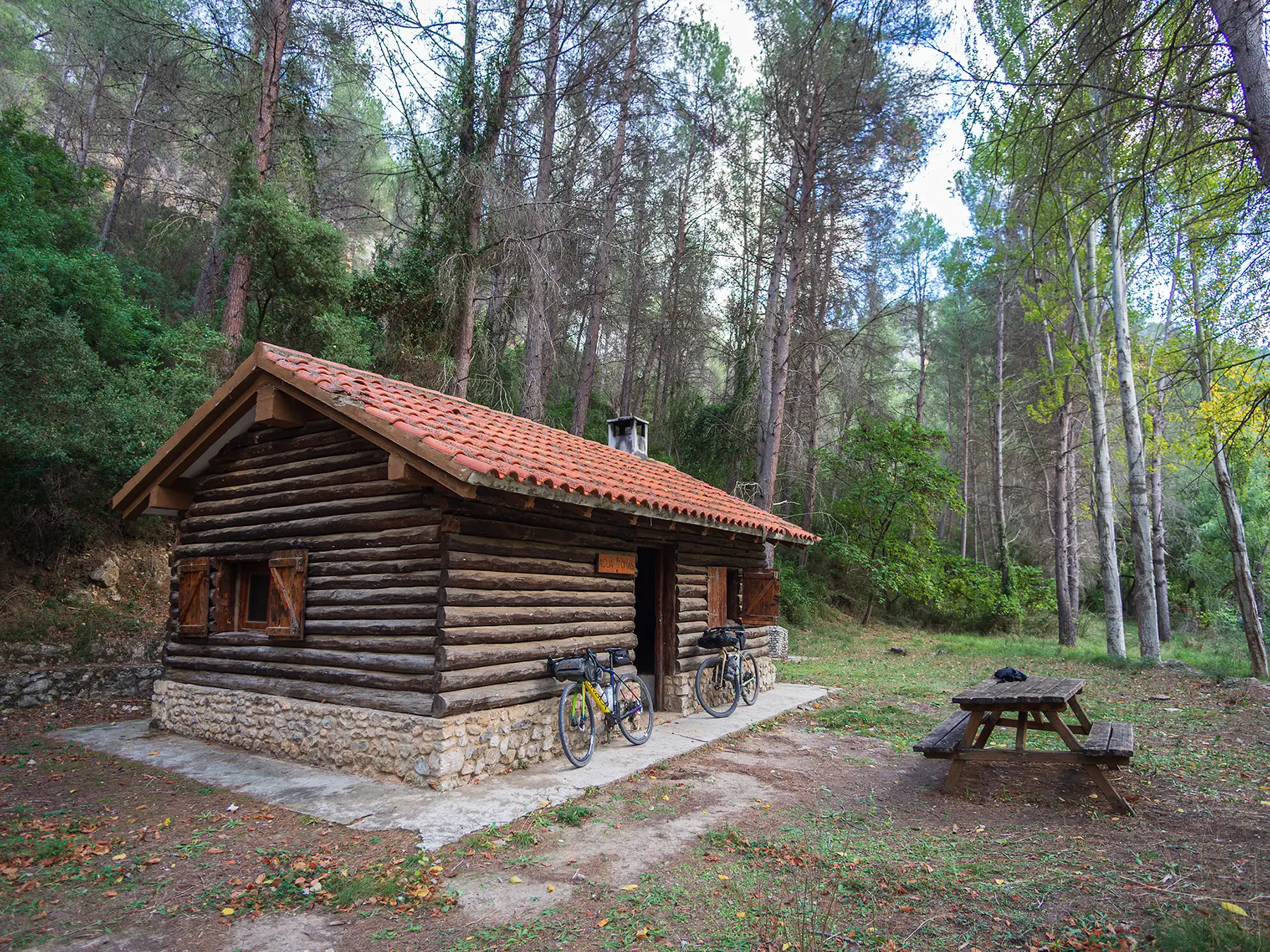
Our destination for the night was the Agua Tomás Forest Shelter. We didn’t know much about what we would find there, and perhaps that’s why arriving became one of those small moments that stay with you long after the kilometres, elevation figures and statistics have faded from memory.
The shelter appeared in a secluded spot, surrounded by nature, with a picnic area and the Túria River flowing peacefully barely thirty metres away. After a full day of pedalling, it felt like nothing short of a five-star hotel.
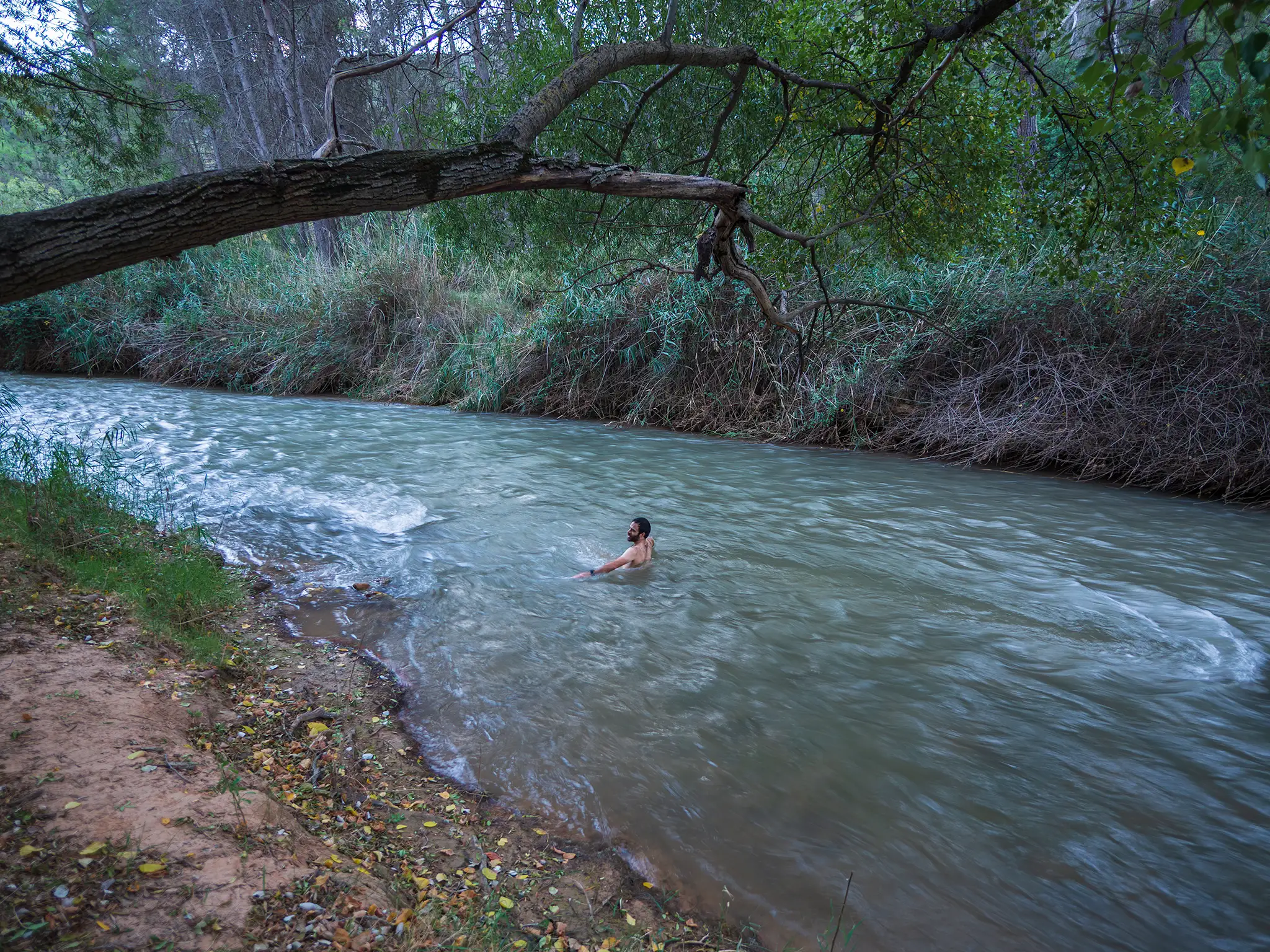
It was 30 October and the temperature gave us plenty of reasons to think twice, but having the river right there eventually overcame any trace of common sense. A quick dip in its cold waters was enough to wash away the dust and some of the fatigue accumulated throughout the day.
Then came the reward: stepping inside the shelter, lighting the fireplace and letting the warmth slowly fill the room.
Outside, the night.
Inside, the fire.
Sometimes, you really don’t need much more.
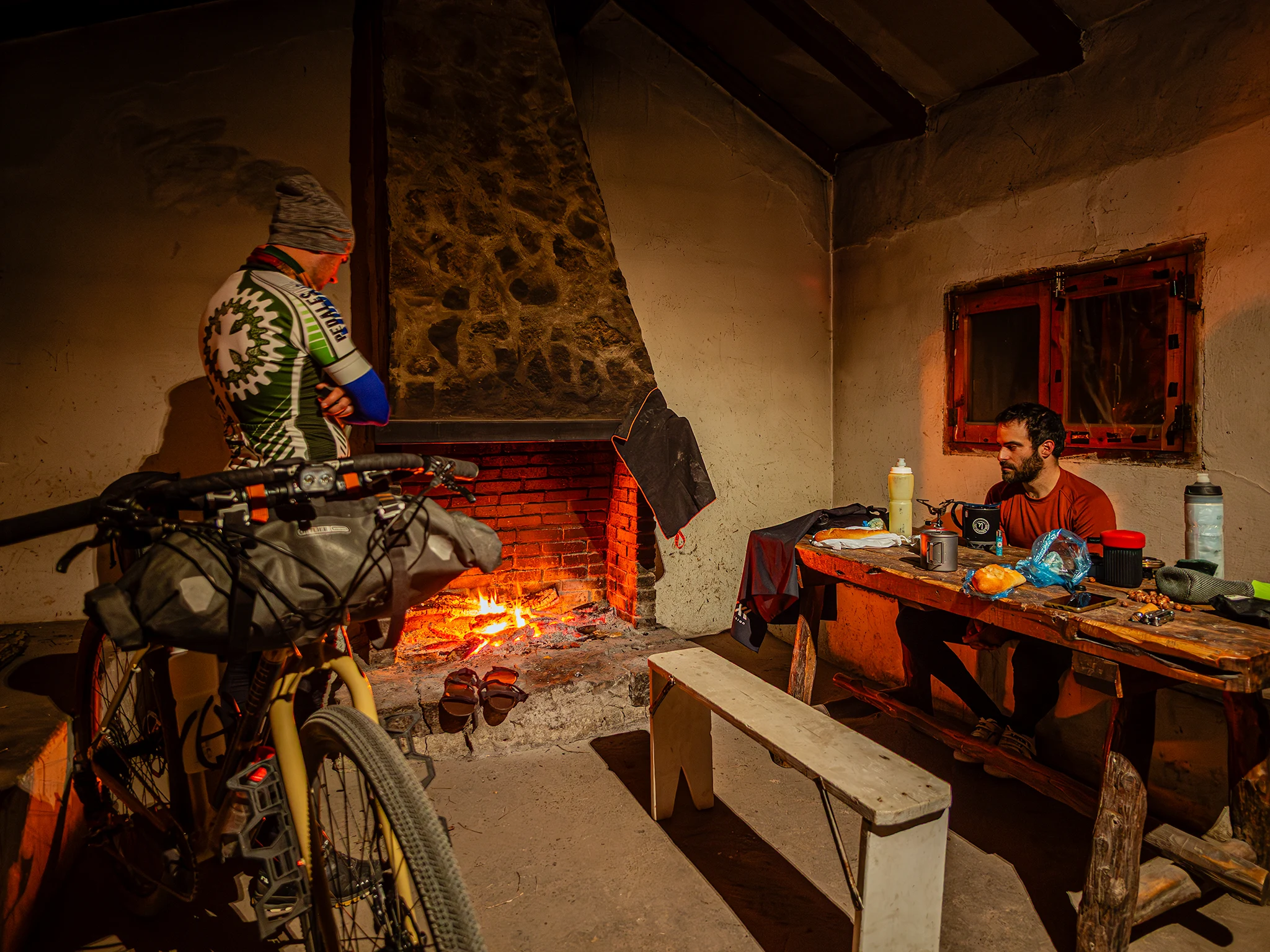
The darkness of that corner of the Alto Turia was far too tempting an invitation to leave the camera packed away. So there was still time to head outside and photograph the night. Night photography usually means long waits out in the cold, but this time there was a trick to it: I could spend a while beneath the stars and then retreat to the warmth of the shelter and its fireplace.
That way, night photography didn’t seem quite so extreme.
We slept warm while, outside, the Túria kept flowing.
The next morning, the cold was still there waiting for us. But few things make peace with a chilly morning easier than wrapping your hands around a hot cup of coffee while listening to the sound of running water.
Sitting beside the shelter, that first coffee was all we needed to start imagining a second day every bit as enjoyable as the first.
It was time to pack up.
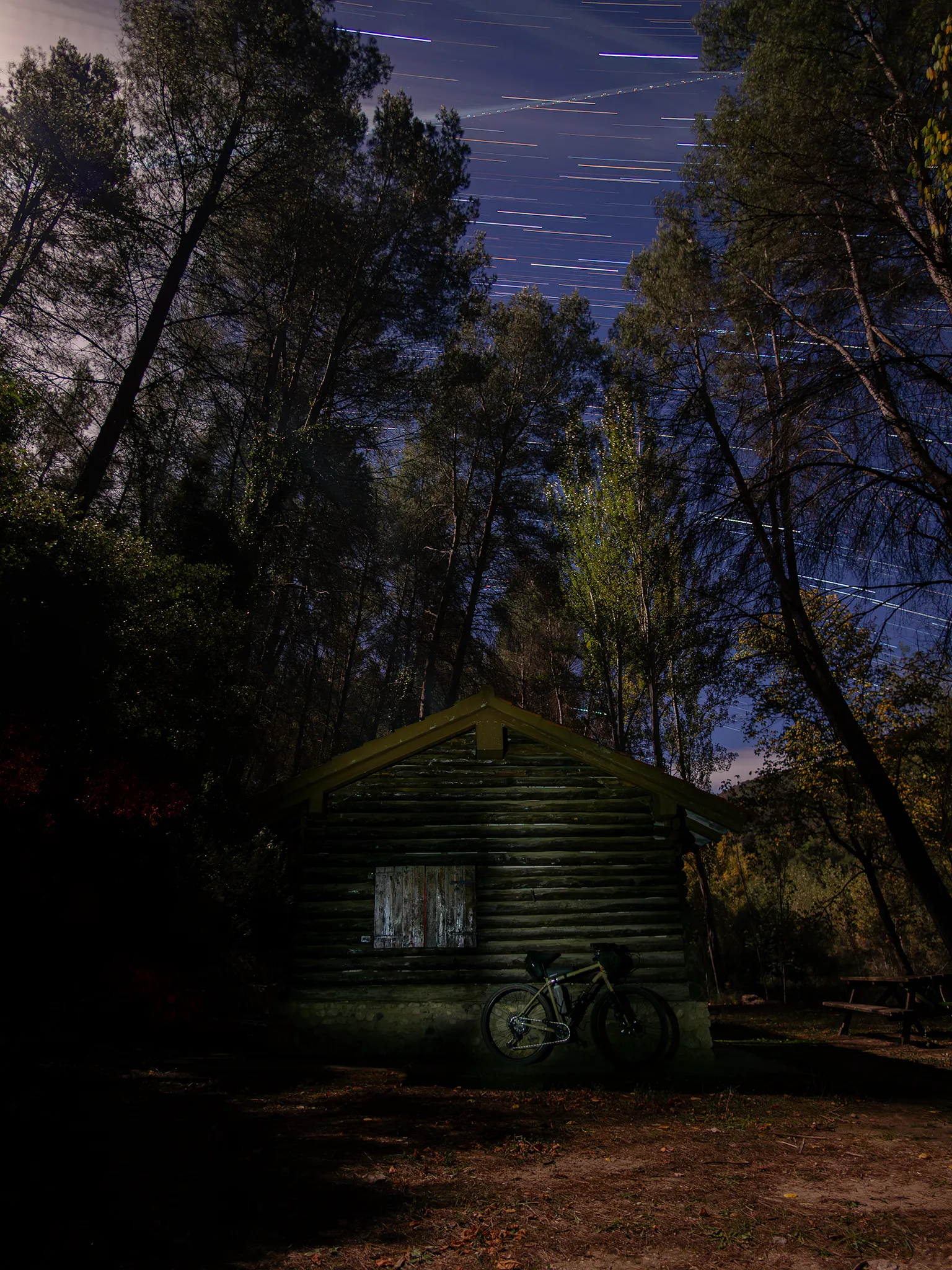
Loading the bikes again, packing our things, cleaning and tidying the shelter for whoever came next. Far from feeling like a chore, those small, mechanical tasks took on something of a ritual. Packing, folding, sweeping, making sure everything was left just as we had found it. Simple actions that required little thought and that, as our hands worked, seemed to slowly erase the tiredness from our legs.
When we got back on the bikes, our bodies had already accepted that there was another full day ahead.
And so it was.
Another day of tracks, forests, small villages and stops without paying too much attention to the clock. Following the philosophy of slowbiking, we could continue enjoying the landscape without turning the ride into a race for kilometres.
Because perhaps that’s one of the things I love most about travelling by bike: moving through a place fast enough to keep going, yet slowly enough to realise that you are actually there.
Different paths, the same drift
As I write this Deriva, I can’t help but think of Deriva Lenta. When we rode these trails back in 2023, the project didn’t even exist. Looking back now, though, it’s curious to recognise in that experience some of the ideas that, two years later, would eventually shape DL.
Rodera and Deriva Lenta are different projects, born in different places and driven by their own ideas, but there’s something beautiful about discovering other people who look at the land in a similar way. People who understand that designing a route isn’t simply about connecting two points as efficiently as possible.
There is another way.
Taking the back road. Choosing a track over a paved road, even if it means taking a small detour. Riding into that village you seemingly had no reason to visit. Stopping beside a river. Sleeping in a shelter. Looking up from the GPS.
Perhaps there’s actually very little that is new about slowbiking.
For centuries, those who travelled along the assagadors already moved in tune with the land. The paths weren’t there to get somewhere faster, but simply to make it possible to get there. They skirted villages, crossed mountains and sought out the passages that allowed livestock to move between the coastal pastures and the highlands.
We carry loaded bicycles instead of herds, follow a digital line instead of animal tracks, and seek experiences rather than pastures. Yet there is something familiar in that way of moving forward.
Perhaps travelling slowly isn’t so much a new way of exploring the land as it is a way of recovering something we had forgotten.
Returning
If what we experienced during those two days is representative of the rest of the Camí dels Assagadors, I’m convinced Rodera is well on its way to becoming one of my favourite routes.
And perhaps the best thing is knowing that it’s still there.
Close to home.
Waiting.
Riding just a small part of it hasn’t diminished my desire to discover the rest. Quite the opposite. Now I want to follow that line all the way to the end, play around with the track, wander off it, come back, explore the paths branching away from it and understand a little better a land that, for far too long, has been so close to me and, at the same time, so far away.
Someday the time will come to ride the entire Camí dels Assagadors: setting off from the Mediterranean, leaving the sea behind to venture deep into the Valencian mountains and, many kilometres later, finding it again at the other end of the journey.
Until then, I’ll hold on to that cold morning beside the Túria, the smell of the fireplace still clinging to our clothes, and two loaded bicycles standing before a path that carried on ahead.
After all, that’s what the assagadors have always been for.
To keep moving forward.
Would you like to follow Deriva Lenta’s journey?
Some Derivas are best told slowly, once the path has had time to settle.
If you feel like accompanying these journeys when they find their moment, the slowletter is a good way to stay the course.



Leave A Comment